
Slots Temple Registration and Verification
 Available in GB
Eligible adults in Great Britain can register for Slots Temple through its UK-facing account flow. Slots Temple says it verifies every customer’s identity during registration using information such as name, address and date of birth, with automated checks used to confirm that the person is at least 18. The operator can also carry out further verification later when required.
It is useful to separate those checks rather than calling everything “KYC”. Basic age and identity verification happens around registration. Payment ownership checks connect the account to a payment method in the customer’s own name. Additional documents or information can be requested if the automated checks are not enough or if legal, regulatory or security obligations require more information. UK financial vulnerability checks are a separate regulatory process again.
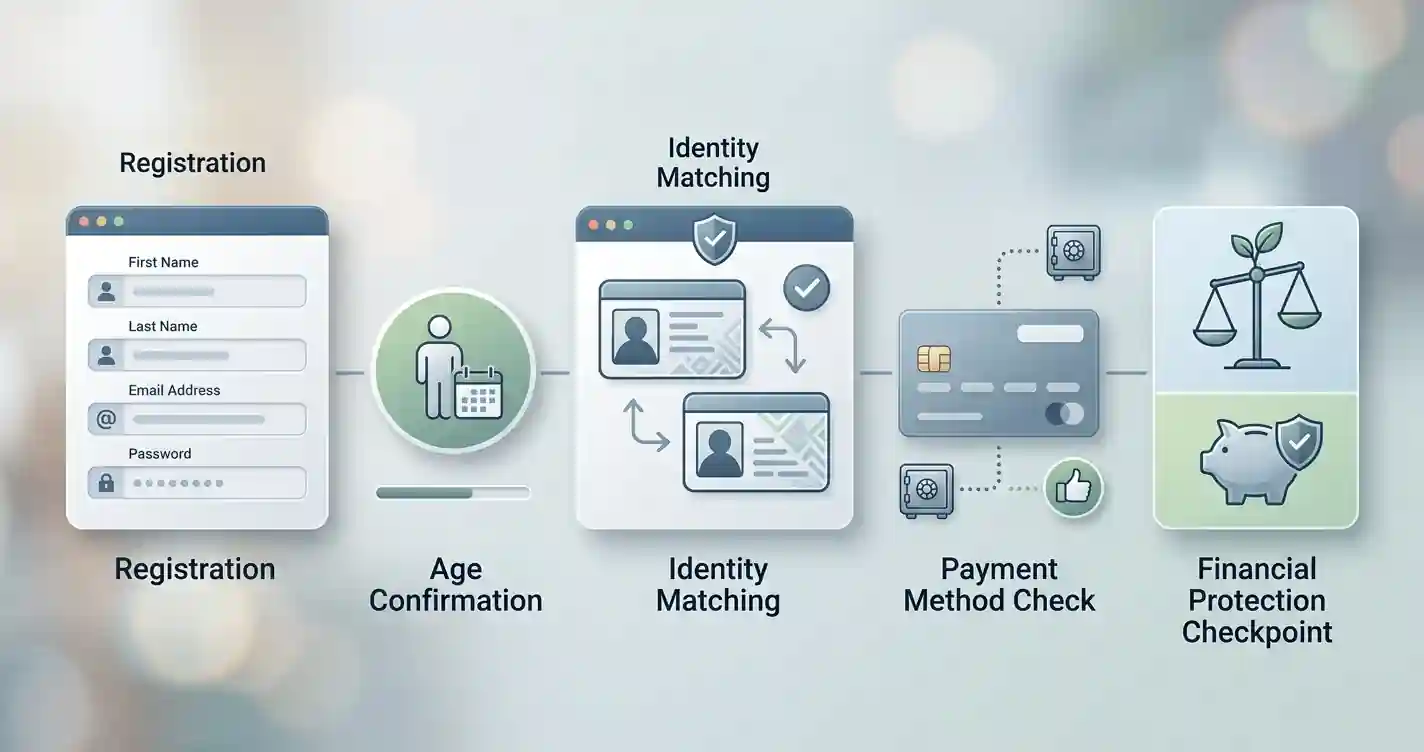
Table of Contents
- The registration process in practical terms
- What information is used for the first checks?
- Automated identity and age verification
- When additional verification may be requested
- Payment-method ownership is a separate check
- What happens if verification is not completed?
- Financial vulnerability checks are not identity checks
- GAMSTOP and age eligibility
- A simple process map
- How to reduce avoidable verification problems
- What to expect from registration and verification
The registration process in practical terms
Slots Temple’s terms require customers to be 18 or over and to provide accurate registration information, including a correct date of birth and country of residence. Its verification support page says the operator checks identity during registration using details such as name, address and date of birth.
The process is designed around electronic verification rather than a universal document upload at the start. Slots Temple says it uses automated soft checks against trusted databases and that those checks do not affect the customer’s credit score. Its safer-gambling material also states that age verification checks are used on every account and that a user whose age cannot be confirmed electronically will not be able to play slots or tournaments.
This does not mean that every customer follows an identical path. Automated verification can succeed with the information already provided, while another account can need extra documentation because data cannot be matched or because a later security or regulatory review is triggered.
What information is used for the first checks?
The official verification page identifies core personal data such as name, address and date of birth. The terms also require accurate registration details and require the customer to keep contact information current.
These details serve more than one purpose. Date of birth supports the age check. Name and address can be matched against trusted data sources. Accurate country and contact information help the operator maintain the account and send important notices where required.
A mismatch does not automatically mean wrongdoing. People move house, data sources can be incomplete, and spelling or formatting differences can occur. The relevant point is that the operator must be able to establish who is using the account and whether that person is eligible to gamble.
Automated identity and age verification
Slots Temple states that its registration verification is automated. Its public “How Slots Temple Works” page also says it verifies user ages using Experian and checks GAMSTOP status. The purpose of these checks is to prevent underage gambling and stop a customer who is covered by a GAMSTOP exclusion from accessing the gambling services that exclusion covers.
Automated does not mean optional. If the electronic process cannot confirm the required information, access can be restricted while the operator seeks more information or documents. That is normal for a regulated gambling account and should not be confused with a promise that every account will pass without further review.
A fixed completion time would be misleading because a customer’s data can require additional handling, even though the support page describes the automated check as fast.
When additional verification may be requested
Slots Temple’s current terms say it can carry out further verification checks and request extra documents or information to confirm matters including identity, age, address and payment-method details. Those are categories of information, not a fixed mandatory document checklist that every player must submit.
That distinction matters. A passport, driving licence, utility bill or bank statement might be familiar examples in the wider industry, but the current official information does not establish that every Slots Temple customer must provide a particular combination of those documents. A universal list would incorrectly turn possible requests into a fixed rule.
If Slots Temple asks for additional information, follow the request shown in the secure account or official support channel. Do not send extra personal documents just because a third-party review says they are commonly requested elsewhere.
Payment-method ownership is a separate check
Slots Temple’s current deposit guidance requires a personal UK-issued debit card that belongs to you and is registered in your own name. Business debit cards are not allowed. The withdrawal guidance also links cashouts to an eligible debit card and states that, after a deposit, the same card must be used for withdrawals for security reasons.
That means payment ownership can overlap with identity verification without being the same thing. The operator can know your name and age but still need to establish that the payment method belongs to you. Keeping account and card details consistent reduces avoidable friction.
For the actual funding rules, see the Slots Temple deposits. For cashout processing, use the withdrawal guide. Payment ownership is a verification issue; banking timings are covered separately.
What happens if verification is not completed?
The Slots Temple terms say failure to provide requested documentation or information can lead to account restrictions, suspension or closure and can affect funds while legal or regulatory obligations are addressed. The wording is broad because the exact response depends on why the information was requested and what remains unresolved.
The practical lesson is to respond through official channels and provide only what has actually been requested. Check that messages come from the slotstemple.com domain or from the logged-in help centre. Slots Temple’s security guidance says genuine customer-support and marketing emails use the slotstemple.com domain and that the operator will not ask for your password.
If you are unsure whether a request is genuine, contact support through the help centre rather than replying to a suspicious message or following an unfamiliar link.
Financial vulnerability checks are not identity checks
Great Britain regulation requires remote operators to conduct a financial vulnerability check when the regulatory threshold is met. Since 28 February 2025, the threshold is where deposits minus withdrawals exceed £150 in a rolling 30-day period, unless a relevant check has already been conducted within the applicable regulatory window.
The UK Gambling Commission describes this as a public-record check for significant indicators of financial vulnerability. It can include indicators such as bankruptcy or certain court and debt-relief records. The purpose is to identify potential financial harm and support proportionate customer interaction.
This is different from asking whether your name, address and date of birth match during registration. It is also different from confirming ownership of a debit card. Keeping these processes separate makes it easier to understand why an account that passed ordinary identity verification can still be subject to another regulatory check later.
GAMSTOP and age eligibility
Slots Temple is for adults aged 18 and over in its Great Britain gambling service. Its public material states that it checks age and GAMSTOP status. If a user is covered by a GAMSTOP exclusion, they should not be able to access gambling with participating Great Britain-licensed operators while that exclusion remains active.
GAMSTOP is not an identity document and should not be described as part of the same KYC step. It is a multi-operator self-exclusion system. The check uses identity data to determine whether the person is covered by an exclusion, but the purpose is safer gambling rather than proving a payment method or resolving an address mismatch.
The broader regulatory and player-protection context is covered in the Slots Temple UKGC licence.
A simple process map
- Create the account. Provide accurate personal details, including date of birth and residence information.
- Electronic checks run. Slots Temple uses automated identity and age verification and checks GAMSTOP status.
- Play only if eligibility is confirmed. If age cannot be confirmed electronically, gambling access is not enabled.
- Use payment methods in your own name. The current deposit route requires a personal UK-issued debit card belonging to the account holder.
- Respond if extra information is requested. Additional information can relate to identity, age, address or payment authorisation, depending on the reason for the check.
- Recognise separate regulatory checks. Financial vulnerability checks can apply later when the UK threshold is reached and are not ordinary registration KYC.
This sequence is a process map, not a promise that every account encounters every step. The point is to show what each check is trying to establish and where it fits in the account lifecycle.
How to reduce avoidable verification problems
- Enter your legal name and date of birth accurately rather than using shortened or invented details.
- Keep your address and contact details current if they change.
- Use a payment method that belongs to you and matches the account holder.
- Do not open a new account to work around a restriction, self-exclusion or unresolved verification issue.
- Use the official site and help centre when submitting sensitive information.
- Never provide your password in response to an email or support request.
- Answer the specific request made by the operator instead of uploading unrelated documents.
These steps do not guarantee instant approval. They simply reduce mismatches that can make an otherwise routine verification more complicated.
What to expect from registration and verification
Slots Temple uses automated identity and age verification during registration for eligible Great Britain adults. Its official material identifies name, address and date of birth as data used in that process, and its terms allow further checks when needed for identity, age, address, payment-method details and regulatory obligations.
The most useful way to understand the process is to avoid putting every check under one KYC label. Registration identity checks, debit-card ownership, GAMSTOP screening and financial vulnerability checks answer different questions. Additional requests are conditional, so there is no justified universal document checklist or guaranteed verification time.
If you want to assess the operator and licence behind those controls, return to the Slots Temple review or use the dedicated safety and licence page. For deposits and withdrawals, use the dedicated banking guides rather than treating account verification as a substitute for banking information.
Published by the Slots Temple Casino team.